
The artists of Lyon pay tribute to Claude Bourgelat, Pauline Jaricot and Claudine Thévenet
The painted walls created by the Cité Création studio form a spectacular trail that has earned them international recognition and made Lyon the capital of this kind of mural art.
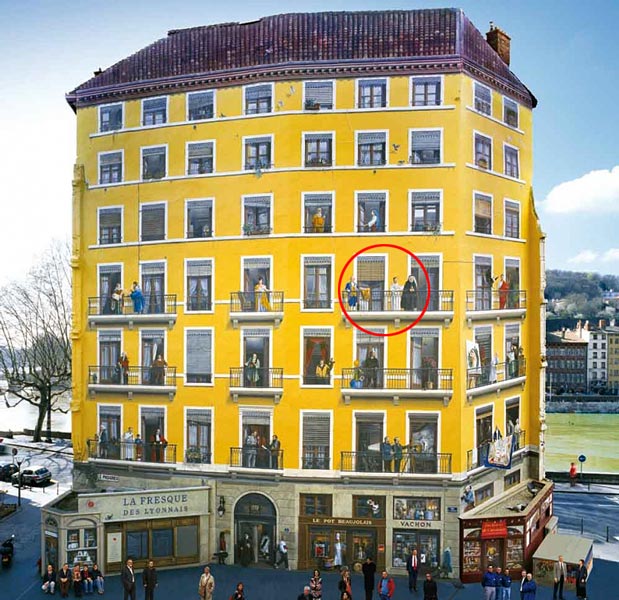
The Fresque des Lyonnais mural
The mural stands at the corner of Quai Saint-Antoine and Rue de la Martinière, in Lyon’s 1st arrondissement.
This gable wall was blind — expert hands gave it back its sight. An unobstructed view of thirty faces of men and women who « made » Lyon. The higher you climb the storeys, the further back you travel in time. From one balcony to the next, the wall is a theatre.
Do go and see this work for yourself — it is well worth the visit.
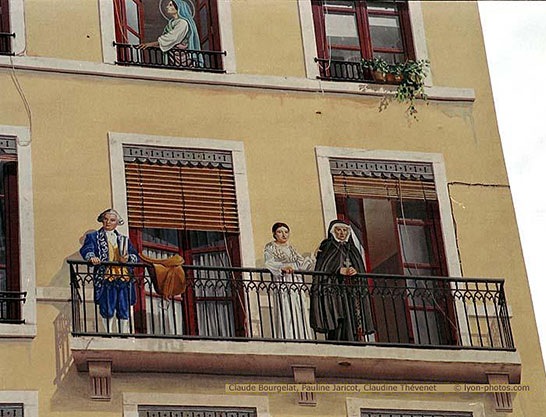
Copyright Lyon-photos.com
Claude Bourgelat (1712-1779)
Claude Bourgelat, a veterinarian born in Lyon on 27 March 1712, died on 3 January 1779.
He is rightly regarded as the immortal creator of veterinary schools in France.
Claude Bourgelat had developed a taste for horses while serving in the cavalry; he studied everything then known of the veterinary art, and applied particular zeal to the study of the anatomy of the horse and of domestic animals.
He thus drew analogies and parallels that probably played a part in the grand conceptions of Vicq d’Azyr and Cuvier.
He fought a host of old prejudices and errors, and was the first to give the veterinary art a scientific direction.
He founded the Lyon Veterinary School in 1762; he was head of the city’s Academy, a member of the Academy of Sciences in Paris, and Commissioner General of the royal studs.
Pauline Jaricot (1799-1862)
Venerable
Her cause for beatification was introduced on 18 January 1930.
On 22 April 1952, the preparatory congregation on the heroic nature of her virtues was held.
On 25 February 1963, Pope John XXIII signed the decree proclaiming the heroic virtues of Pauline Marie Jaricot. That is why she was declared « venerable », meaning that the Church commits itself to her beatification.
But a miracle, as proof of her intercession, is a necessary condition. It depends on heaven, and on a movement of prayer here below, as a sign of mutual complicity in obtaining the supreme glorification.
Her life
Pauline Jaricot, the last of the seven children of a family of silk merchants, was born in Lyon on 22 July 1799, at a difficult time for the Church in France.
The clergy was divided: on one side the « juring » priests of Gallican leaning, on the other the « refractory » priests loyal to Rome.
The political powers naturally backed the first tendency, whose strongman was Cardinal Fesch, Archbishop of Lyon and uncle of Napoleon Bonaparte; this Church, with its « juring » and « official » clergy, also held the baptismal registers. But the Jaricot family were friends of the « refractory » priests, and Pauline was baptised at home.
A lively child, she led a carefree life in a very devout and well-off milieu, « alive with her own life », as she joyfully wrote.
A fall from a very high stool on which she had climbed shocked her nervous system. Her mother’s death, then a sermon by Father Würtz, led her, at seventeen, to a resolute conversion.
With the same passion, she threw herself into loving God in His creatures, and Christ in the poor and the incurable of the hospital.
Among the working women she organised the group of the « Réparatrices » (« my sacred battalion », as she called it), and followed the biblical catechesis given to the hospital staff by the young chaplain, Clément Villecourt, a future cardinal.
Mission entered her spiritual project through her dreams of becoming a missionary in China — dreams shared with her brother Philéas, and taken up again later when he himself joined the « Congregation of young men and gentlemen ».
This association, almost secret, of piety and action, collected funds for the Foreign Missions of Paris, in support of the missions in the Far East.
Pauline supported her brother, then at the Seminary of Saint-Sulpice, through a steady correspondence. But, unable to go to Asia herself, she looked for another way to help the missions. She received an appeal to help the mission in Louisiana, home to a French colony and to missionary priests and bishops.
Pauline discovered that mission was not only in Asia — that the Church’s mission is universal. As she would confess, « the whole earth seemed to me made fruitful by the presence of this divine Saviour in the Most Blessed Sacrament. From that came the correspondence with my brother, then at the Seminary of Saint-Sulpice in Paris
From this correspondence with my brother and from this personal disposition came the « Propagation of the Faith ».
As early as 1818, Pauline had begun to collect one « sou » a week — less than a tenth of a euro today — from the 200 women workers in her brother-in-law’s factory.
She then launched a new method based on the decimal system: each person associated with the work of the Propagation of the Faith was to find ten others who, in turn, would each find ten more, thus forming « hundreds » and even « thousands » of promoters and benefactresses, ad infinitum. The « tens », « hundreds » and « thousands » collected the weekly contributions of ten, one hundred and one thousand associated members respectively.
A plan of extreme ease and simplicity — and an effective one, nourished by a Eucharistic spirituality — spread in a short time from Lyon to the other regions.
In 1822, Pauline quietly left the direction of the « Propagation of the Faith » in other hands.
The source of the work appears clearly in « Infinite Love in the Divine Eucharist », which she wrote at the age of 23.
The communion of hearts, praying and meditating each day on the whole life of Jesus, creates an immense spiritual force in the Church.
In the Jubilee year of 1825, Pauline brought to life another providential work, the « Living Rosary », applying the same method as before to the associated recitation of this Marian prayer, but replacing the number of ten associates with fifteen (the mysteries of the Rosary being fifteen in number).
Fifteen people must be found, each entrusted every month with reciting one decade of the rosary daily, while meditating on the corresponding mystery of the life of Jesus. This mystery, drawn by lot, changes every month. In addition, each associated member seeks five further members who, in their turn, seek to multiply the membership.
The Living Rosary spread like wildfire through France, Canada, Latin America, Asia and the whole world, and it still endures in many places.
While these two concrete initiatives met with real success and wide diffusion, Pauline’s third initiative was created with a social aim: to help the workers.
It was first a bank offering interest-free loans, then an industrial venture that failed because of a few unscrupulous intruders.
That bankruptcy became the cross of the final period of her life. She died in 1862, having lost her entire fortune.
Today, the work of the Propagation of the Faith has its seat in Rome, where it was transferred in 1922 upon receiving the title of « Pontifical » work. It is present in 144 countries across the five continents and has 107 national offices throughout the Catholic world.
Source / Pauline Jaricot: Archivum Vaticanum