

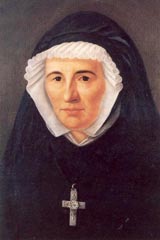
Ste. Claudine Thévenet, an inspiration for our educational mission…
When, in the aftermath of the French Revolution, Ste. Claudine Thévenet agreed to care for orphaned girls, she did not begin by picking and choosing. These little girls were dirty, with no upbringing and no schooling. She washed them, brought them up and gave them solid training, to make of them honest silk-workers, ready to face the new life opening before them.
This approach, quite innovative for its time, has always remained the spearhead of the teaching tradition of the Sisters of Jesus and Mary; and when the sisters opened the Notre-Dame institution, it was above all in that pedagogical spirit: giving the young people entrusted to them a solid education, to make of them adults ready to enter working life.
Today, even though the Sisters of Jesus and Mary have left the school group, that idea remains the driving force of our institution: enabling every young person who joins us — whatever their school level or social background — to leave having received the education they need for a career path in which they can flourish.
In this way, Ste. Claudine Thévenet continues to watch over and care for every young person entrusted to her.
Claudine Thévenet (1774-1837)
Saint
Saint Claudine Thévenet — Marie de Saint-Ignace in religion — was beatified by John Paul II on 4 October 1982 and canonised on 21 March 1993.
In the aftermath of the Revolution, in 1818, she founded in Lyon the Congregation of the Religious of Jesus and Mary, devoted to the education of the young. She was a friend of Pauline Jaricot, the « mother of the missions ».
« Following in the footsteps of Saint Claudine Thévenet, be — for everyone, and especially for the young and for children — ardent witnesses of forgiveness and mercy, looking upon them in a way that reveals in each one a promise, an expectation, an epiphany of the divine presence » (cf. homily for the canonisation of Claudine Thévenet, 21 March 1993). Such was the recommendation of Karol Wojtyła, Pope John Paul II.
The artists of Lyon pay tribute to Claude Bourgelat, Pauline Jaricot and Claudine Thévenet find out more…
Her life
The second of seven children, Claudine Thévenet was born in Lyon on 30 March 1774. « Glady », as she was affectionately known, showed from an early age a happy influence over her brothers and sisters through her kindness, her gentleness and her selflessness in giving pleasure to others.
She was fifteen when the French Revolution broke out. In 1793 she lived through the tragic hours of Lyon besieged by government forces, and watched, powerless and horrified, the execution of her two brothers, killed in reprisal after the fall of the city in January 1794. Their last words, which she gathered into her heart and made her own — « Glady, forgive, as we forgive » — marked her deeply and gave a new meaning to her life. From then on she devoted herself to relieving the countless miseries brought by the Revolution; for her, ignorance of God was the main cause of the people’s suffering, and a great desire awoke in her to make Him known to all; children, and above all the young, drew her zeal, and she longed to make them know and love Jesus and Mary.
Her meeting with a holy priest, Father André Coindre, helped her discern God’s will for her and proved decisive for the direction of her life. Having found two little girls, abandoned and shivering with cold, on the square in front of the church of Saint-Nizier, Father Coindre brought them to Claudine, who did not hesitate to take them in.
Compassion and love for abandoned children thus lie at the origin of the « Providence » of Saint-Bruno, in Lyon (1815). Companions joined Claudine; they formed an association, the Association of the Sacred Heart, of which Claudine was immediately elected president. On 31 July 1818, the Lord’s call made itself heard through the voice of Father Coindre: to form a community without hesitation. « God has chosen you », he told Claudine. And so the Congregation of the Religious of Jesus and Mary was founded on 6 October 1818, at Pierres-Plantées on the Croix-Rousse hill. In 1820 the young Congregation settled at Fourvière (opposite the famous shrine), on land bought from the Jaricot family. It received canonical approval from the diocese of Le Puy in 1823 and from Lyon in 1825.
The young Institute’s first aim had been to take in poor children and keep them until their twentieth year, teaching them a trade alongside elementary schooling, and giving them a solid religious and moral formation. But they wanted to do more, and Claudine and her sisters opened their hearts and their arms to the daughters of well-to-do families, founding a boarding school for them. The apostolic aim of the Congregation would thus be the Christian education of all social classes, with a preference for children and the young, and among them for the poorest.
The two works grew side by side, despite the trials that accompanied the Foundress through the last twelve years of her earthly pilgrimage: the deeply felt deaths of Father Coindre (1826) and of the first sisters (1828); the struggle to prevent her Congregation from being merged with another; and the revolutionary upheavals of Lyon in 1831 and 1834, with all their consequences for the inhabitants of Fourvière, which stood at a strategic point between the two opposing sides.
The Foundress’s remarkable courage was never cowed by adversity; she boldly undertook new building work, including the chapel of the Mother House, while devoting the greatest care to drafting the Constitutions of her Congregation. She was about to put the finishing touches to them when death took her, in her sixty-third year, on 3 February 1837.
« To do everything to please God » seems to have been the guiding thread of her life. This constant search for God’s will, to « lead a life worthy of the Lord and pleasing to Him in every way », was the path that gave her a keen spiritual sensitivity for reading the signs of the times and discerning God’s designs for her so as to respond fully; it was also the path that earned her a « share in the inheritance of the saints in the light » (Col 1: 10, 11).
« To see God in all things and all things in God » is also to live in a spirit of praise. In a world too often without hope, rediscovering the goodness of the Creator, present in His creation and in people, gives life back its meaning and invites thanksgiving. Claudine made of her religious and apostolic life a « praise of glory » to the Lord; her last words — « How good the good Lord is » — were an exclamation of wonder at the goodness of God, which she had learned to recognise even in the most painful moments of her life.
Claudine stamped her Congregation with her strong personality. Gifted with uncommon strength of soul, a clear-headed woman and a born organiser, she was above all a woman of
heart, and she wanted her daughters to be true mothers to the children in their care: « You must be mothers to these children, » she said, « yes, true mothers of both soul and body. » No partiality, no favourites: « the only ones I allow you are for the poorest, the most wretched, those with the most faults; those, yes, love them dearly. »
The soundness of a building shows in the test of time. Barely five years after the Mother’s death, her daughters set out for India (1842). In 1850 they opened their first house in Spain, and in 1855 they settled in the New World, in Canada.
One hundred and seventy-five years after the Congregation’s foundation, the Religious of Jesus and Mary today number more than one thousand eight hundred, in 180 houses across the five continents. They welcome with joy and gratitude the canonisation of the humble and generous daughter of France whom the Lord chose to be their Foundress.
Source / Claudine Thévenet: Archivum Vaticanum
Claudine Thévenet — D’une colline à l’autre (From one hill to another)
D’une colline à l’autre is a book published by Yvette Durand-Carrier / the Jesus-Mary Family of Villefranche-sur-Saône / the Association of Former Pupils and Friends of Jesus-Mary.